Earlier this year Smart confirmed that it is creating a new miniature two-seater – the unique proposition for which the brand was invented three decades ago – several years after foraying into electric SUVs.
The brand had some difficulty in building a business case for the #2 – but even so, its progress through the pipeline has been a lot smoother than that of the original City Coupé.
Autocar first reported on the project in February 1990, and the next summer its instigator, Nicolas Hayek, did a deal with Volkswagen.
The Lebanese-born 63-year-old, who we described as “a rumpled, cigar-chomping management consultant”, was well known as the driving force behind Swatch.
Having overseen the liquidation of two Swiss watchmakers engulfed by new competition such as Casio, from 1985 he drastically reduced the number of parts, almost fully automated the production process and took a bold, creative approach to marketing, and by 1990 Swiss watches were outselling Japanese ones by a factor of three.
Enjoy full access to the complete Autocar archive at the magazineshop.com
Hayek described his Swatchmobile to us as a small electric car that could carry “two people and two cases of beer” for a price of £3570 (that’s £8280 today).
“I don’t know cars, just like I didn’t know watches,” he said. “I am just a fat old man who has kept his fantasy as it was when I was six years old.
“What makes me tick is starting something new, building something, changing something. “I have more than enough money; it would be a pleasure to contribute to something good, something that will fight against the decadence of this civilisation.”
He wasn’t alone in his thinking: General Motors, Volkswagen, BMW, Nissan and several start-ups were at the time also endeavouring to bring EVs out of sci-fi and onto our roads.
“It’s got to be a real car, not one of these toy electric things they have now,” continued Hayek. “That’s why we’re putting electrical engineers in charge of the project instead of automotive engineers.”
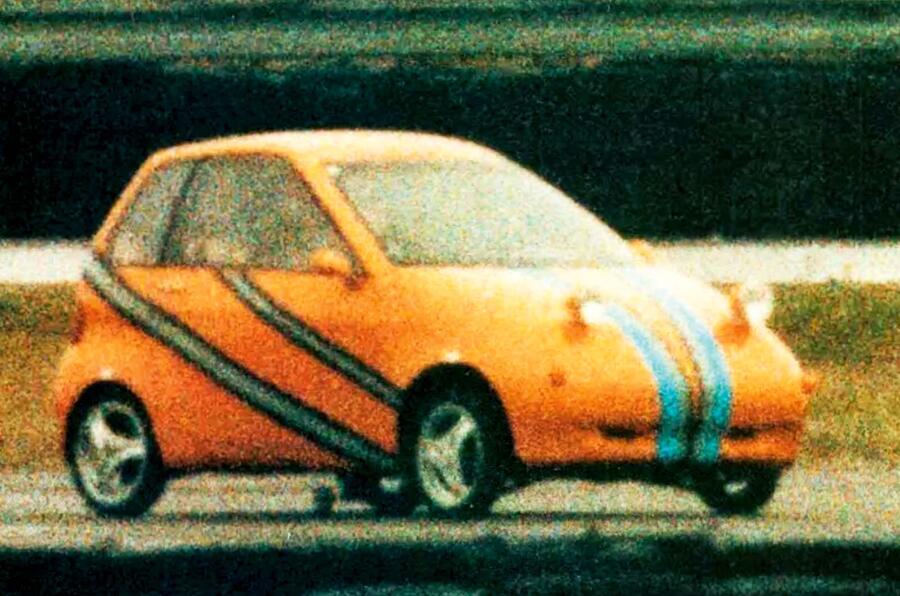
We first spied the Swatchmobile testing as 1993 dawned – by which point its launch had already been delayed by two years to 1997. Battery technology hadn’t advanced as much as expected, making a short range and a high price inevitable.
But “Hayek’s goal was to sell the chic Swatch car so cheaply that it becomes both classless and trendy”, forcing a change to a hybrid system featuring a 250cc four-stroke petrol engine and a lead-acid battery.
Hayek planned to “offer an extended range of bright body colours and bodystyles using plastic body panels; a revolutionary system of removable paint films will permit owners to change the colour of the Swatch to suit their mood”.
Although Volkswagen was backing the project, the car had largely been developed by Swatch in Biel, with help from the local engineering college. Still, this was a tough time for the car maker, as losses mounted and production plummeted.
And so when Ferdinand Piëch became big boss, he slashed investment and fully prioritised Wolfsburg’s own hybrid city car, the ill-fated Chico.
“Our own car seemed a much better proposition,” Piëch later recalled. “For me, [the Swatch] was an elephant’s roller skate – not even a practical bubble car.”
It seemed Hayek’s fantasy was in tatters – until a saviour emerged in the form of Mercedes-Benz, whose management had been shaken into changing its conservative culture.
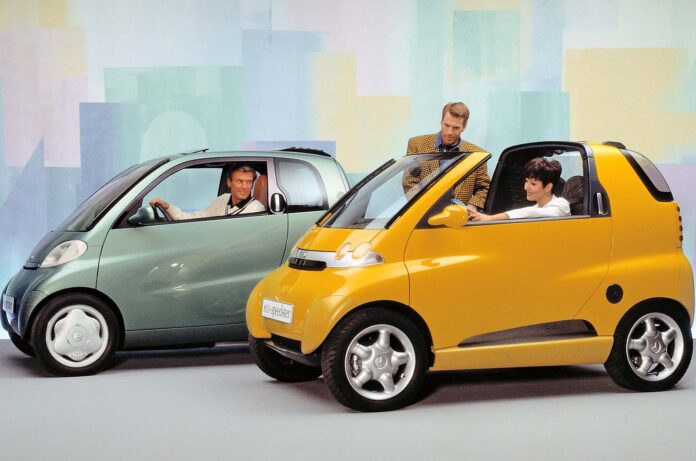
Mercedes designers were already working on a similar idea, and in early 1994 this was presented in the form of twin electric concept cars, coinciding with the announcement of a Mercedes-Swatch joint venture named Micro Compact Car (MCC).
A year on, we saw an all-new car testing. Engineered in Renningen by a small team of 166 – average age 34 – it used two-cylinder petrol and diesel engines and was built to the ‘sandwich principle’ of the new A-Class to ensure crash safety. Diesel hybrid and hub-motored electric versions were planned for later.
Then in May 1995 came a new name: Smart. S for Swatch, M for Mercedes and ART for art’s sake. Furthermore, a ‘revolutionary’ factory with Smart’s 30 suppliers on site would be built in Hambach, France, for £305m (£533m today).
Hayek’s fantasy – or Mercedes’ equivalent of it – finally manifested in May 1997. “The future of mobility will be the Smart,” MCC chairman Jürgen Hubbert predicted. Maybe this time he will be proven right.

