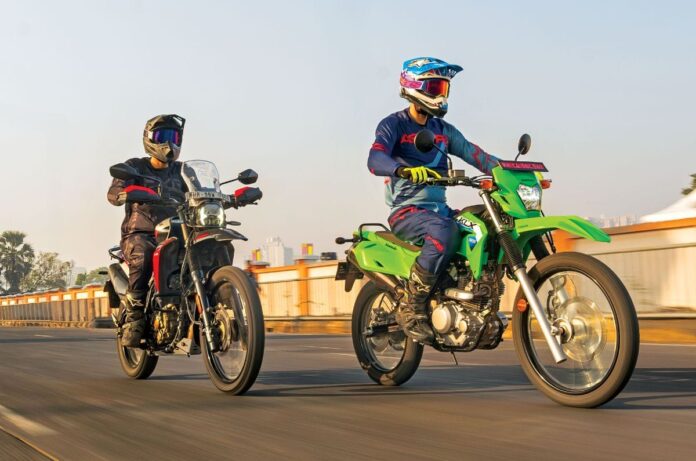
The newly localised Kawasaki KLX230 entering the mix at a much more realistic price has made the entry-level, off-road-capable segment in India more interesting than ever. In fact, it now sits close enough to the Xpulse 210 to make this a meaningful comparison, yet they approach the same mission with very different philosophies.
Hero Xpulse 210 vs Kawasaki KLX230 design and ergonomics
The KLX230 looks like a proper dual sport whereas the Xpulse 210 has a more modern, ADV design
At first glance, the KLX230 looks every bit the trail-focused dual-sport bike it is meant to be. The localisation update has introduced subtle but important changes to the bodywork, exhaust routing and certain engine components, but the overall silhouette remains lean, stylish and functional. Despite its raw and simple appearance, the KLX is not poorly built. Panel fit is clean, the welds on the now-made-in-India frame are tidy, and the overall construction feels robust. It does not try to look premium, but it certainly does not feel cheap either.
KLX’s seat is great off-road but understandably not very practical
The Xpulse 210, in comparison, carries a more modern and fuller adventure-bike stance than the 200. The fairing, tank and side panels have an everyday friendliness that suits its broader role. It feels more contemporary, but not necessarily more durable, and both bikes execute their respective identities well.
.jpg "Hero Xpulse 210 seat")
It gets a comfy seat with mounting points.
Ergonomically, the KLX230 immediately communicates its trail heritage, and its tiny 7.6-litre tank and slender chassis allow riders to grip the bike effortlessly between the legs, giving a strong sense of control. Seated, the flat seat provides excellent freedom to move fore and aft for weight shifts during climbs and descents. However, the handlebar sits lower than ideal for extended standing, and riders of most sizes will benefit from a taller handlebar. Comfort is further limited by the stiff, narrow, dirt-bike style seat.
.jpg "Hero Xpulse 210 and Kawasaki KLX230 off-road")
The Xpulse 210, by contrast, offers an ergonomics package that suits everyday life far better. The seating triangle is relaxed, the handlebar position is natural, and the plush, broader seat makes long rides vastly easier. Standing up is comfortable too, though the scooped seat restricts the amount of rearward movement available when seated off-road. It is not a disadvantage on most trails, but it does highlight how the Xpulse is tuned for general usability rather than pure off-road technique. Taken as a whole, the Hero is the more comfortable motorcycle for all round use, while the Kawasaki excels for riders who spend serious time on trails.
| Tested performance | ||
|---|---|---|
| Hero Xpulse 210 | Kawasaki KLX230 | |
| ACCELERATION | ||
| 0-60kph (acceleration) | 3.90s | 4.15s |
| 0-100kph (acceleration) | 11.2s | 11.82s |
| ROLLING ACCELERATION | ||
| 20-50kph (roll-on acceleration) | 2.50s | 2.58s |
| 30-70kph (roll-on acceleration) | 4.44s | 4.62 |
| 50-80kph (roll-on acceleration) | 4.30s | 4.45 |
Hero Xpulse 210 vs Kawasaki KLX230 Performance, ride and handling
The KLX230 is more appropriate for low-speed riding
Out on the road, the Xpulse 210 presents a more eager power delivery. It feels smoother through the revs, and its cleaner low-end response makes it easier to navigate traffic or climb to cruising speeds. This matches its slightly stronger 0-60kph and roll-on acceleration figures, which translate directly into its more relaxed urban performance. The short gearing, along with a crisp and engaging sound and good refinement, makes it the sweeter engine on the road.
.jpg "Kawasaki KLX230 headlight")
Marginally brighter headlamp is nice but very expensive to replace
The KLX230 tells a different story. It may not match the Xpulse’s outright pace on the road, but the way it makes its power is tailored to off-road riding. Its thumpy, immediate response at low speeds gives you a higher sense of acceleration, and it feels more appropriate for lower speed riding, just like you’ll find in tricky off-road situations. The tractable bottom end helps during tight trail sections, steep climbs or loose surfaces, where delicate throttle work matters more than outright acceleration that arrives at higher revs. On tarmac, it requires more effort to build speed and feels the less relaxed of the two, but off road, it feels alive and encouraging in a way the Hero does not quite match.
| Full specifications | |||
|---|---|---|---|
| Hero Xpulse 210 | Kawasaki KLX230 | ||
| Engine | Single-cyl, 210cc, liquid-cooled | Single-cyl, 233cc, air-cooled | |
| Power | 24.6hp at 9250rpm | 19hp at 7800rpm | |
| Torque | 20.7Nm at 7250rpm | 19Nm at 6200rpm | |
| Gearbox | 6-speed | 6-speed | |
| Seat height | 830mm | 880mm | |
| Ground clearance | 220mm | 255mm | |
| Fuel carrying capacity | 13-litres | 7.6-litres | |
| Wheelbase | 1446mm | 1370mm | |
| Kerb weight | 170kg | 139kg | |
| Brakes (F/R) | 276mm disc / 220mm disc | 290mm disc / 230mm disc | |
| Tyres (F/R) | 2.75-21 45P / 4.10-18 59P | 90/90-21 / 120/80-18 | |
| Suspension (F/R) | Telescopic fork / monoshock | Telescopic fork / monoshock | |
The localisation update has significantly changed the way the KLX230 behaves on rough and smooth surfaces. The new suspension setup has 20/27mm less suspension travel than before, but it now has firmer springs and is no longer as excessively soft and easily compressed as before.
.jpg "Hero Xpulse 210 headlight")
The recovery bar is a neat touch
You feel more of the imperfections of broken city roads, but there are positives as well. The bike resists bottoming out far better than before, especially during rocky climbs or harsh compressions, giving the rider more confidence to push. This firmer character has also tightened up road manners and, combined with its light weight, makes the KLX230 an absolute hoot to ride home from work. There is less pitch under acceleration and braking, and the KLX now holds its line more cleanly through fast corners. The improved behaviour under hard braking, combined with the larger disc, makes it noticeably better at shedding speed.
The KLX’s massive weight advantage amplifies all of this. Being a massive 31kg lighter than the Xpulse, it responds instantly to inputs, changes direction with minimal effort, and feels far more manageable on technical trails. In fact, the KLX230 is so light and manageable that I’d be a lot more confident venturing into the unknown alone with it,given the considerably lower effort it would take to recover in case of a fall. This low mass also contributes to its stability off road, since the suspension does not have to work as hard to control the chassis. In most situations, this suspension does well for the kind of amateur/fun riding this bike is expected to provide, but there were a few rare instances where we did miss having the extra travel from the CBU model.
.jpg "Kawasaki KLX230 rock crawling")
While there’s plenty of room to move around on the KLX, the standing ergos are not very natural
The Xpulse 210 delivers a more rounded ride quality, and its suspension strikes a balance that suits India’s mix of tarmac and uneven surfaces. It is not as communicative or agile as the KLX off road, but it offers significantly greater comfort and capability on the road, be it in the city or over long distances. Off road, its 210/205mm of suspension travel and 220mm of ground clearance mean it is capable and confidence-inspiring, though it lacks the KLX’s playfulness and sheer ease when the terrain becomes truly demanding.
Back to back, the Xpulse’s lower suspension travel and ground clearance sometimes become apparent, especially over rocky terrain, but what you will mainly notice is the extra weight it carries. The bike can get through much of the same terrain as the KLX, but its rider will need more skill and stamina over longer rides to do so.
Hero Xpulse 210 vs Kawasaki KLX230 features and practicality
The Xpulse 210 comes with a TFT whereas the KLX230 sticks to the basics
.jpg "Kawasaki KLX230 LCD dash")
LCD dash is pretty bare-bones
On equipment, the Xpulse 210 comfortably takes a big lead. The TFT display, even with its matte finish that occasionally compromises visibility, adds real everyday usability through Bluetooth connectivity, turn-by-turn navigation and call control. The dual-channel ABS with three modes allows riders to personalise the braking behaviour depending on the surface, something genuinely useful for mixed-use riding.
.jpg "Hero Xpulse 210 TFT dash")
Xpulse’s TFT is the opposite
The KLX230 remains intentionally stripped back, and its monotone LCD has only the basics, lacking a gear indicator or tachometer. The single-channel ABS can be switched off, but the process feels unnecessarily complicated. There is no connectivity or rider aids, and the bike relies almost entirely on rider skill. For some, this simplicity is the appeal, but in a market that values features, the KLX’s minimalist approach does stand out.
Hero Xpulse 210 vs Kawasaki KLX230 Price and verdict
Post localisation, the KLX230 is now priced at Rs 1.84 lakh, whereas the Xpulse 210 is priced from Rs 1.62 lakh
Localisation has reshaped the KLX230’s position entirely. What was once an expensive, niche trail bike is now a much more competitively priced option. Even so, the Xpulse 210 remains the more affordable motorcycle, not only in terms of initial purchase but also in ongoing service and spare part costs. Hero’s extensive network and lower running expenses make a noticeable difference here.
.jpg "Hero Xpulse 210 and Kawasaki KLX230 in a frame")
Choosing between the two ultimately depends on the riding you intend to do. The Kawasaki KLX230 is easily the more focused machine. It rewards technique, encourages exploration and delivers a level of connection that makes off-road riding more engaging. The Hero Xpulse 210 is the more well rounded of the two. It is quicker and smoother in everyday use, significantly more comfortable, far better equipped and much easier on the wallet in the long term. For most riders who want a single motorcycle to handle commuting, touring and occasional off-road fun, the Xpulse remains the smarter purchase.

